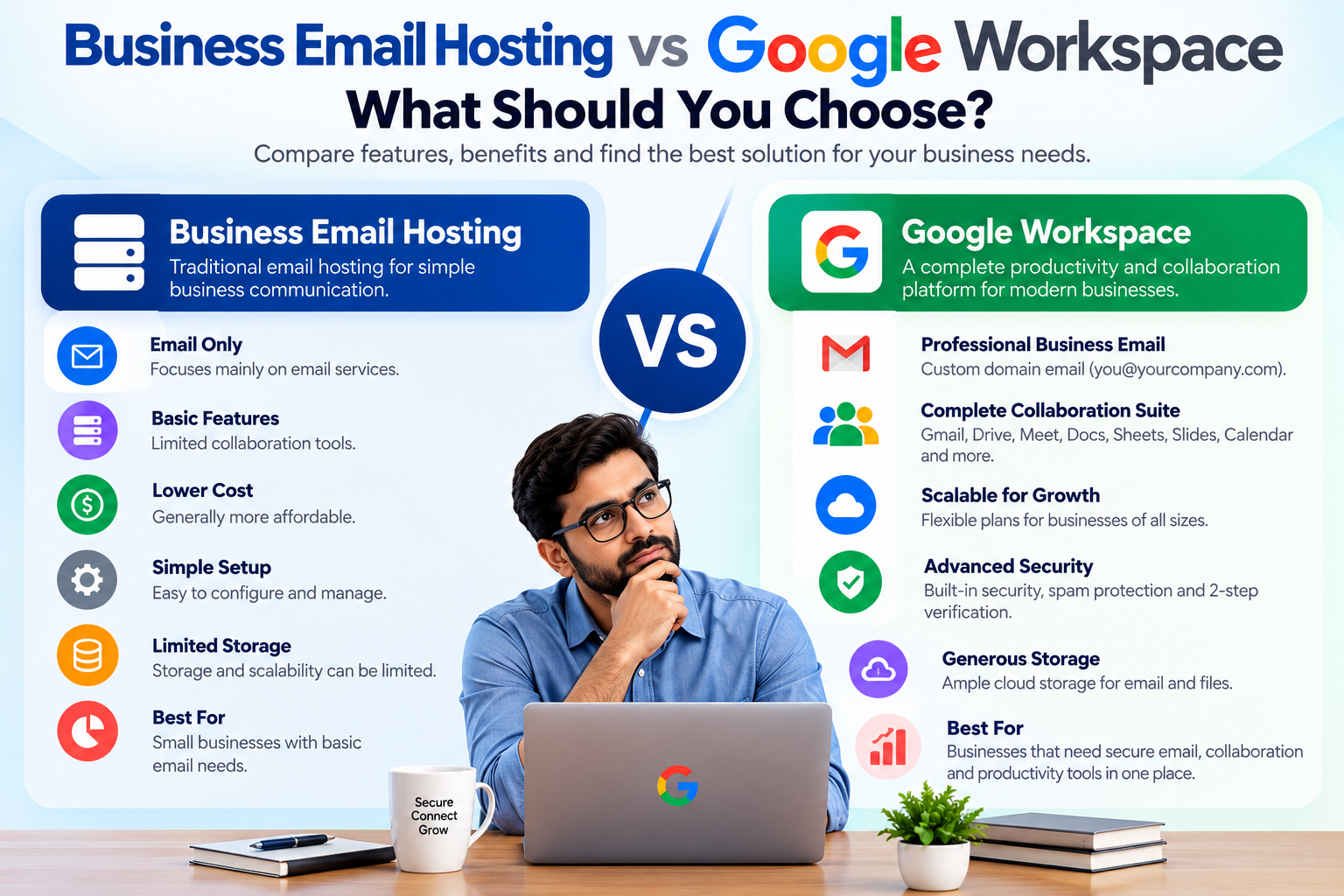
Business Email Hosting vs Google Workspace: What Should You Choose?
A professional email address is essential for most modern businesses. However, companies have several options when deciding how to host their email.
Traditional business email hosting and Google Workspace can both provide domain-based email, but they are designed around different requirements and workflows.
Understanding the differences can help businesses select an environment that matches their operational needs.
What Is Business Email Hosting?
Business email hosting generally refers to an email service where a provider hosts mailboxes for a company’s domain.
For example, a company may have email addresses such as sales@company.com and support@company.com hosted on a traditional mail server.
Depending on the provider, the service may include mailbox storage, spam filtering, webmail, IMAP, SMTP, and related email functionality.
Traditional hosting can be appropriate for businesses that primarily need email and have relatively simple collaboration requirements.
What Is Google Workspace?
Google Workspace combines business email with a broader productivity ecosystem.
Along with Gmail for business email, organizations can use services such as Google Drive, Google Docs, Google Sheets, Google Meet, and Google Calendar.
This makes Google Workspace more than an email hosting service.
Collaboration Differences
One major difference is collaboration.
Traditional email hosting may provide the basic communication layer, while files and documents may need to be managed through separate platforms.
Google Workspace is designed around cloud collaboration. Teams can work on documents, spreadsheets, presentations, and files without constantly exchanging attachments.
For organizations with distributed teams, this can be useful.
Administration
Both environments require administration, but the available management capabilities differ between providers.
Google Workspace provides an administrative environment for managing users, security settings, applications, groups, and other organizational controls.
Businesses should consider who will manage these settings before choosing a platform.
Security
Security should be a major consideration for business email.
Regardless of the platform, businesses should configure strong authentication, appropriate access controls, spam protection, and domain authentication.
For Google Workspace environments, administrators can implement security policies and manage user access centrally.
Scalability
Businesses also need to consider future growth.
A company may begin with five employees and eventually grow to fifty, five hundred, or more.
The email platform should make it practical to add users, manage accounts, assign appropriate licenses, and maintain consistent policies as the organization grows.
Cost Considerations
Price is important, but businesses should consider the total cost rather than comparing mailbox prices alone.
Traditional hosting may appear inexpensive when the requirement is limited to basic email.
However, businesses may need additional services for document collaboration, video meetings, cloud storage, security, backup, and other productivity requirements.
Google Workspace combines several capabilities under a business-focused platform, which can change the overall value calculation.
When Professional Support Matters
Whichever platform a business chooses, configuration and administration remain important.
DNS records, SPF, DKIM, DMARC, user accounts, security settings, migration, and mail-flow configuration can all affect the reliability of business email.
TechFuse MarkTech supports businesses with Google Workspace, business email infrastructure, migration, administration, and related server services.
Which Environment Fits Your Business?
There is no single configuration that works for every organization.
A business that needs only basic email may have different requirements from an organization that needs cloud collaboration, centralized administration, online meetings, shared documents, and integrated productivity tools.
The decision should therefore be based on the company’s users, applications, security requirements, collaboration needs, budget, and future plans.
Final Thoughts
Traditional email hosting and Google Workspace can both support professional business communication, but they serve different operational needs.
Google Workspace provides a broader productivity ecosystem alongside business email, while traditional hosting may focus primarily on email services.
For businesses considering Google Workspace, TechFuse MarkTech can assist with setup, migration, administration, security, and ongoing email infrastructure management.